
Contents
Overview
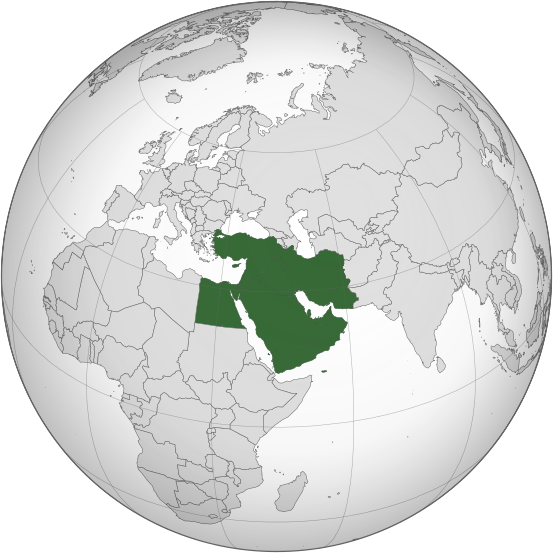
Middle East politics is a complex and volatile arena defined by a dense web of historical grievances, competing nationalisms, religious ideologies, and external interventions. This region, encompassing nations from Egypt to Iran and Turkey to Yemen, has been a crucible for major world religions and empires, leaving a legacy that profoundly shapes contemporary power dynamics. Key issues include the Israeli-Palestinian conflict, the rise and fall of regional hegemons like Saudi Arabia and Iran, the impact of oil wealth on governance, and the persistent struggle between authoritarianism and democratic aspirations. The region's strategic importance, particularly concerning global energy markets and international security, ensures its perennial place at the forefront of global geopolitical discourse, making its political currents a subject of intense scrutiny and analysis by powers both within and outside its borders.
🎵 Origins & History
The political landscape of the Middle East is a palimpsest of ancient empires and colonial legacies. The Ottoman Empire's collapse after World War I carved up territories and sowed seeds of future conflict. The arbitrary drawing of borders created states like Iraq and Syria that would later grapple with internal divisions. The discovery and exploitation of vast oil reserves, particularly in the Arabian Peninsula, further complicated matters, leading to immense wealth for some states but also fueling external interest and proxy conflicts, notably during the Cold War era.
⚙️ How It Works
At its core, Middle East politics operates through a confluence of state-centric diplomacy, non-state actor influence, and the pervasive role of identity politics. National governments, ranging from monarchies like Saudi Arabia and Jordan to republics like Egypt and Turkey, wield significant power, often characterized by centralized authority and strong security apparatuses. However, the region is also home to powerful non-state actors, including groups like Hezbollah in Lebanon and the Houthi movement in Yemen, which challenge state sovereignty and engage in regional power plays. Religious and sectarian identities, particularly the Sunni-Shia divide, are frequently mobilized for political gain, influencing alliances and fueling conflicts across borders, such as the proxy wars in Syria and Yemen. External powers, including the United States, Russia, and China, also play a crucial, often destabilizing, role through military presence, arms sales, and diplomatic maneuvering.
📊 Key Facts & Numbers
The sheer scale of geopolitical significance is staggering: the Middle East holds approximately 48% of the world's proven oil reserves, a fact that underpins much of its international political leverage and vulnerability. Over 200 million people inhabit the region, with a median age of around 25, indicating a large youth population that presents both demographic dividends and potential for social unrest. The region accounts for roughly 30% of global oil exports, with countries like Saudi Arabia and UAE being major players in organizations like OPEC. Military spending in the region exceeded $150 billion in 2022, reflecting ongoing security concerns and arms races, particularly between Iran and its regional rivals. The economic disparities are also vast, with some nations boasting GDPs in the trillions, while others, like Yemen, face humanitarian crises with GDPs in the tens of billions.
👥 Key People & Organizations
Key figures and organizations are central to understanding the region's political currents. Monarchs like King Salman bin Abdulaziz Al Saud of Saudi Arabia and Sultan Haitham bin Tariq of Oman represent ancient dynastic power. Political leaders such as Recep Tayyip Erdoğan in Turkey and Bashar al-Assad in Syria embody the complex national leadership challenges. The Islamic Republic of Iran, under the guidance of its Supreme Leader Ali Khamenei, exerts significant regional influence, often in opposition to the GCC, a bloc of six Arab states including Qatar and Kuwait. International bodies like the United Nations and regional organizations like the Arab League attempt to mediate disputes, though their effectiveness is often constrained by member state rivalries and external pressures from global powers like the United States and Russia.
🌍 Cultural Impact & Influence
Middle East politics has profoundly shaped global culture, religion, and international relations. The region is the birthplace of Judaism, Christianity, and Islam, faiths that have spread worldwide and continue to influence billions. The ongoing Israeli-Palestinian conflict has been a dominant theme in international diplomacy and media for decades, shaping global perceptions of justice and human rights. The region's strategic importance has led to numerous Hollywood films and geopolitical thrillers, embedding images of deserts, ancient ruins, and political intrigue into global consciousness. Furthermore, the diaspora communities from Middle Eastern countries have contributed to the cultural fabric of cities across Europe, North America, and Australia, introducing diverse cuisines, music, and perspectives, while also often becoming focal points for political advocacy and debate concerning their homelands.
⚡ Current State & Latest Developments
The current geopolitical moment in the Middle East is marked by a complex recalibration of alliances and a persistent undercurrent of conflict. The Abraham Accords, brokered by the United States, have normalized relations between Israel and several Arab nations, including the United Arab Emirates and Bahrain, signaling a potential shift away from the traditional Arab-Israeli alignment. Simultaneously, the rivalry between Saudi Arabia and Iran continues to play out through proxy conflicts in Yemen and Syria, despite recent diplomatic overtures. The ongoing Syrian Civil War remains a brutal humanitarian crisis, with multiple international actors involved. In the Palestinian territories, tensions remain high, with periodic escalations of violence. The region is also grappling with the economic fallout from fluctuating oil prices and the increasing impacts of climate change, particularly water scarcity, which could exacerbate existing tensions.
🤔 Controversies & Debates
The definition of the 'Middle East' itself is a point of contention, with varying geographical and political interpretations. Some scholars and policymakers prefer terms like 'West Asia' or 'North Africa and West Asia' to avoid Eurocentric biases or to better reflect geopolitical realities. The role of external powers, particularly the United States and Russia, in shaping regional conflicts and political outcomes is a subject of intense debate, with critics arguing for greater regional autonomy and others emphasizing the necessity of international engagement for stability. The effectiveness and legitimacy of regional organizations like the Arab League are frequently questioned, with debates centering on their ability to enforce resolutions or mediate effectively amidst deep-seated national interests. Furthermore, the ongoing struggle between authoritarian regimes and nascent democratic movements, particularly in the wake of the Arab Spring uprisings, remains a critical point of contention regarding the region's political future.
🔮 Future Outlook & Predictions
The future of Middle East politics is likely to be shaped by several key trends. The ongoing energy transition away from fossil fuels could diminish the region's global economic leverage, forcing a diversification of economies and potentially altering power dynamics. The demographic bulge of young people will continue to present challenges and opportunities, with potential for both innovation and instability depending on governance and employment prospects. The resolution, or continued stalemate, of the Israeli-Palestinian conflict will remain a critical factor in regional stability. Increased cooperation on issues like climate change adaptation and water management may emerge as a necessity, potentially fostering new forms of regional diplomacy. The evolving relationship between major powers like the United States, China, and Russia in the region will also be a significant determinant of future security architectures and political alignments.
💡 Practical Applications
Understanding Middle East politics has direct implications for global finance, energy markets, and international security. The price of oil, a commodity heavily influenced by regional stability, directly impacts economies worldwide, affecting everything from transportation costs to inflation rates. Geopolitical developments in the Middle East can trigger significant fluctuations in global stock markets and currency values. Furthermore, the region's strategic location makes it a critical transit poin
Key Facts
- Category
- politics
- Type
- topic